SISPAD 2009

I am glad I went to this year’s SISPAD 2009. There were many fascinating papers and I had the opportunity to meet with several researchers doing some interesting work.

There were many papers using Non-Equilibrium Green’s Functions~(NEGF). I’ve always had difficulty in understanding the approach, but Dipanjan Basu from the University of Texas at Austin gave me one of the best explanations.

NEGF, Monte Carlo (MC), and Spherical Harmonic Expansions of the Bolztmann Equations (SHE) seemed to be popular simulation methods for nano-devices. The molecular dynamics simulations of Dr. K.-R. Lee of KIST were quite impressive showing the interactions of Al and Co atoms.

I am glad to see device simulation using continuum PDE simulation is still considered important. There is also an exciting application of this method and MC to bio-sensor applications.

Dr. Ancona gave an interesting talk using Density Gradient theory to model Sb-based PFET’s. He used the COMSOL multiphysics package to do his simulations. This piqued my interest as I am writing a generalized PDE solver of my own. Being a finite element package (FE), it was surprising he was able to overcome the issues with current density calculations without using Scharfetter Gummel (SG).

Aryan Afzalian also had an interesting paper where he used COMSOL as part of his NEGF simulation method.

One of the most entertaining speakers was Professor Wachutka from TU Munich. He had a fascinating discussion of the importance power devices, and the interesting effects which need to be modeled using TCAD.

In addition to Synopsys, TCAD International and Global TCAD Solutions were TCAD companies sponsoring the event. It is good to see that there is room in the TCAD simulation market.

I was also appreciative that Clemens Heitzinger (University of Vienna) and Yang Liu (Stanford) were there to discuss bio-sensors. Greg Rollins (Synopsys) and Valery Axelrad (SEQUOIA Design Systems) were also kind enough to share their insight into TCAD device simulation issues.

Many thanks to the SISPAD organizers for an excellent conference.
Biosensor Applications in DEVSIM (Part II)

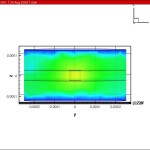
As a follow up to the previous post, here are the results when 3d versions of the structures were created. The active areas are in the center of the device, and the rest of the device are translucent.

Biosensor Applications in DEVSIM

I became interested in replicating the results in this paper:
Y. Liu, J. Sauer, and R. Dutton, “Effect of electro-diffusion current flow on electrostatic screening in aqueous pores,” Journal of Applied Physics, Vol. 103, p.084701, 2008

which Dr. Liu provides on his website here:
http://www-tcad.stanford.edu/~yangliu/

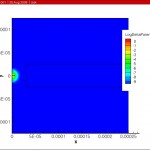
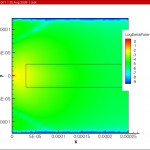
The two plots in this post reflect the effect of a charged macro molecule (e.g. DNA) under biased and unbiased conditions in the structure. The structure has contacts at the top and bottom. The plots for a bias of 0 and 7 volts are included in this post. The plots show the potential difference when the charged macro molecule is present and not present in the aqueous pore to the center left of the picture. More information about the significance of the result may be found in Dr. Liu’s paper.

In order to replicate Dr. Liu’s results, the cylindrical coordinate system was implemented in DEVSIM. The device is cylindrical and the structure is wrapped around the left vertical axis. The PDE’s for the potential and flux densities were implemented in a fashion similar to the standard drift diffusion formalism for TCAD simulation.

Porting DEVSIM to Windows

While our primary development platform is 64-bit Linux, work is in process to get DEVSIM working on 32-bit Windows. It has been challenging, but thankfully the porting process has become easier as compiler vendors have become more standards compliant. It is especially nice that the majority of the third party components of our software already support Windows and Unix-like platforms.

One of the benefits of porting with a new compiler has been to identify code which is not necessarily portable across computer architectures, or entirely C++ standards compliant. This effort has even enabled us to find a few minor defects in our implementation.

I am happy to report that we have a functioning build on Windows, and thorough regression testing is in progress.

Solving for magnetic fields in DEVSIM.

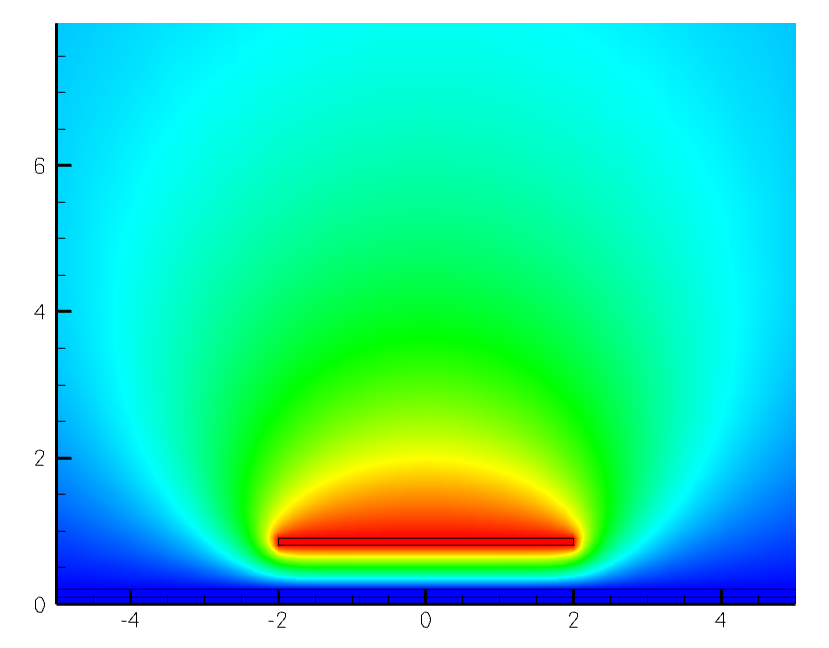
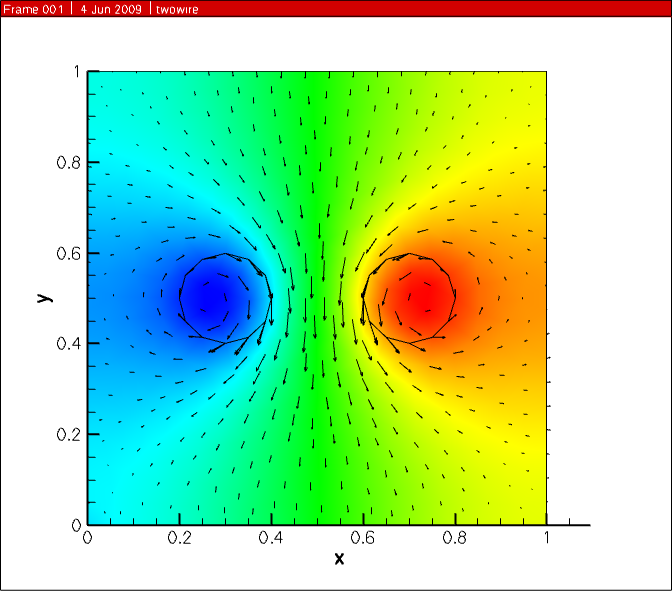
This past week I’ve been experimenting with solving magnetic field problems. Here is my first result. Two wires are in the center of the figure with current flowing in opposite directions. The solution variable is the magnetic vector potential, A, and is shown in the color gradient. The arrows are the magnetic field, B, which is post processed from the solution. In turns out this post processing is similar to finding the vector impedance field used in noise analysis.

twowire1

Writing documentation

Nothing more fun than writing documentation. Of course, no one can use your software if you don’t provide instructions. Contrary to what many software developers believe, providing an example is not the same as providing documentation.